Feed Them First: The Low-Tech Retention Strategy Veteran Organizers Swear By
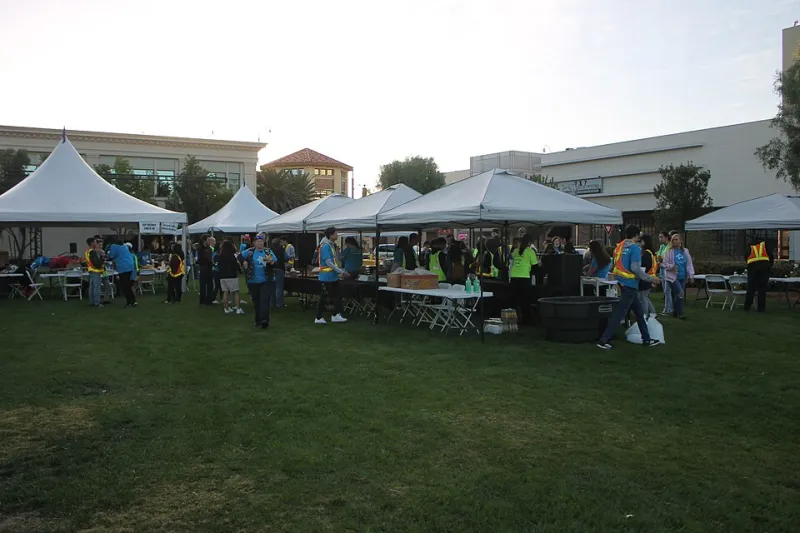
Photo: Noah Wulf, CC BY-SA 4.0, via Wikimedia Commons
Ask a roomful of new organizers what they need to win a campaign, and you'll hear about databases, messaging frameworks, and turnout models. Ask someone who's been doing this for twenty years, and you might get a different answer: bagels.
Not literally bagels, always. Sometimes it's a crockpot of chili at the union hall in Dayton. Sometimes it's the pancake breakfast the tenants' association in Fresno runs before every meeting. Sometimes it's the oneg-style spread after Friday services that the synagogue's social justice committee has quietly leveraged for decades. The specifics vary. The principle doesn't: people come back to places where they get fed.
The Interview That Started This Article
Rosa Delgado has organized in the Rio Grande Valley for over three decades, first with farmworker campaigns and later with a housing coalition. When I asked her what kept volunteers showing up through the grueling stretches — the lost votes, the hostile councilmembers, the August heat — she didn't mention strategy.
"We ate together," she said. "Every single meeting. Tamales, usually. People would come for the tamales and stay for the phone banking. That's not a joke. That's the whole model."
Delgado's take is backed up by what organizers have observed anecdotally forever: retention is the silent killer of new groups. Most start with a burst of energy — a big first meeting, forty sign-ups, a viral moment. Six weeks later, seven people show up. The difference between the groups that survive that cliff and the ones that don't often isn't tactics. It's whether the seven people who came back felt like they belonged to something.
And belonging, in American civic life, has almost always been built around a table.
A Longer History Than You'd Think
This is not a new discovery. The Grange halls of the Midwest ran on covered-dish suppers. The civil rights movement's citizenship schools in the South were held in beauty parlors and church basements where food was always present — partly out of hospitality, partly because organizers understood that a shared meal lowers the temperature of a hard conversation. Labor locals built entire social calendars around fish fries and picnics, and those social events were the glue that held the political work together when contracts got ugly.
Even the term "solidarity" carries this flavor. You don't feel solidarity with an institution. You feel it with people — people whose kids you know, whose cooking you've tasted, whose lawn you've helped mow when they were at the statehouse lobbying until midnight.
But We Only Have $200
Here's the objection every broke organizing group raises, and it's fair: shouldn't that money go to flyers, or a text-banking tool, or the venue deposit?
Maybe. But run the math on what you're actually buying. Fifty dollars of grocery-store coffee, donuts, and fruit buys you something no flyer can: a reason to linger. Meetings that end on time and send people straight home produce acquaintances. Meetings with a half-hour of informal time afterward — ideally with snacks — produce relationships. And relationships are what get your petition signed, your shift covered, and your friend convinced to testify at the zoning hearing.
A few practical rules from the organizers we spoke with:
- Food before flyers, every time. A flyer tells people you exist. A spread on the table tells them they're welcome.
- Potluck beats catering. Asking people to bring something gives them a small stake in the gathering. Ownership starts with a casserole dish.
- Watch dietary needs like a campaign watches precinct data. One person who can't eat anything at the table notices. So does everyone else.
- The food isn't the meeting. Keep it warm and welcoming, then get to work. Hospitality is the on-ramp, not the destination.
The Deeper Point
There's a reason the phrase "breaking bread" shows up in nearly every culture's vocabulary for making peace and building trust. Sharing food is one of the oldest trust signals humans have. In an era when so much of our civic life happens through screens — petitions signed in isolation, comments typed into voids — the simple act of sitting across a table from a neighbor is quietly radical.
So if you're starting a group in your town this month, here's the advice from the veterans: budget for the bagels. Buy the good coffee. Let the meeting run long because people are talking afterward. The platform will come. Feed the people first.